

Dome of the Rock
The gold-domed shrine on Jerusalem’s Temple Mount, completed in 691. Whether non-Muslims can go in, when the platform is open, what to wear, the best places to see it from, and how it fits with the Western Wall in one morning.
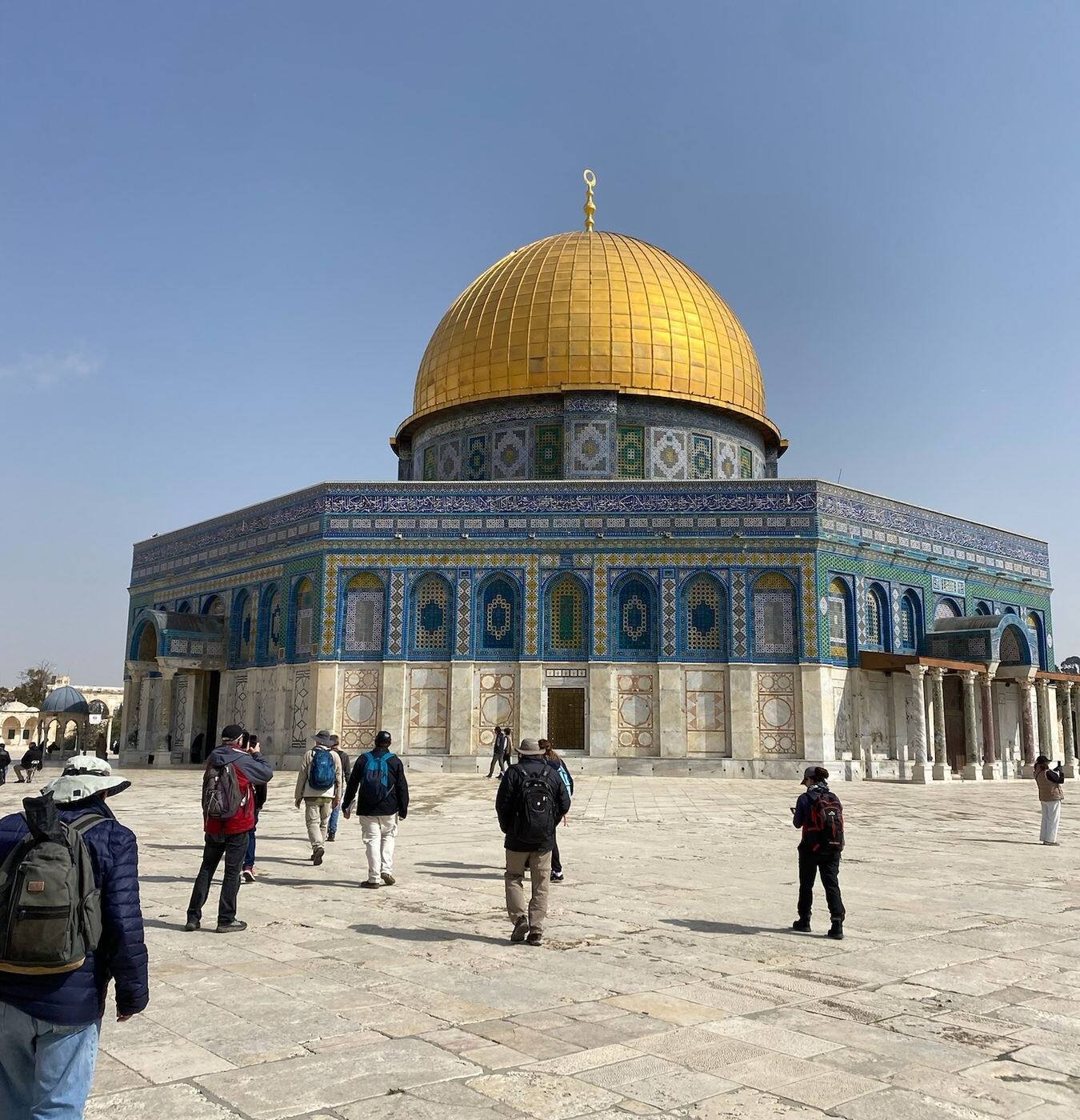
The Dome of the Rock is the gold-domed, blue-tiled shrine that stands at the center of Jerusalem’s Temple Mount, the platform Muslims call the Haram al-Sharif. Completed in 691 under the Umayyad caliph Abd al-Malik, it is among the oldest surviving Islamic buildings anywhere, and it encloses the rock that Jewish tradition identifies as the Foundation Stone and Islamic tradition as the point of the Prophet’s night journey and ascension. It is the image most people carry of Jerusalem, and it sits on the most contested thirty-five acres on earth.
Almost every practical question a visitor has about it — can I go in, when is it open, why is the queue so long, why are there police at the gate — has the same answer underneath: who controls the platform, and on what terms. So that is where I start when I bring a group up, and it is where this page starts too.
Can non-Muslim visitors go inside the Dome of the Rock?
No. The Dome of the Rock and al-Aqsa Mosque are closed to non-Muslims, and have been since 2000. You can walk the platform around them, stand close enough to read the tilework, and photograph the building from every side. You cannot enter.
That disappoints people, so it is worth saying plainly before you climb the ramp. What you get instead is the platform itself, which is the real thing: an engineered surface Herod built to level a hilltop, the reason the retaining walls below are as vast as they are, and the setting in which the shrine makes sense. From the ground the Mount reads as a plaza. Standing on it you understand that the whole thing is artificial.
When can you visit the Temple Mount?
Access for non-Muslims is limited to specific hours and it is subject to change at short notice.
- Days: Sunday to Thursday only. Closed to non-Muslims on Fridays and Saturdays, and throughout Ramadan.
- Hours: typically two short windows, one in the morning and one around midday. They shift with the season and with the security picture, and they are not always announced.
- Entrance: one gate only, the Mughrabi Bridge, the wooden ramp beside the Western Wall plaza. Every other gate is for Muslim worshippers.
- Security check at the bottom of the ramp. Bring a passport. The queue forms early and the window is short.
Because this is the least predictable element in Jerusalem, it goes first in the day and everything else flexes around it. If the platform shuts — which happens — the alternatives are genuinely good, and I cover them below.
Who controls the Temple Mount, and why does it matter for your visit?
Control is divided, which is the root of nearly everything else.
Israel has held sovereignty over the Old City since 1967. Administration of the platform itself stayed with the Jordanian Waqf, the Islamic trust that has managed it for centuries. Israeli police control access and security at the gates. This arrangement, usually called the Status Quo, has governed the site since 1967, and it is renegotiated in practice rather than on paper.
The practical result: the police decide who goes up and when; the Waqf governs what happens inside; and any change to either is treated by every party as a serious matter. That is why the rules are strict, why they change without notice, and why a visit here is unlike a visit to any other monument in the country.
Why is prayer such a sensitive question here?
Under the current arrangements, non-Muslim prayer on the Mount is prohibited, and the prohibition is itself one of the most contested questions in Israel. Police enforce it; visibly praying, bowing or bringing religious articles up can end your visit.
Alongside that runs a second question that surprises people: many observant Jews do not ascend at all. Because the exact location of the Holy of Holies — the inner sanctum only the High Priest could enter, once a year — is not known with certainty, much rabbinic authority holds that Jews should not go up for fear of treading on it in a state of ritual impurity. The Chief Rabbinate posts signs saying so at the entrance. Other authorities permit ascent along specified routes. The disagreement is live and increasingly political, and it is the reason the Western Wall below became the focus of Jewish prayer: it is as close as one can come to the site without going onto it.
I do not run this as a lecture with everything smoothed flat. Three traditions make claims about this ground that cannot all be true at once. What I do is present each as its adherents understand it and be straight about where the disputes lie. On this platform, that honesty is the tour.
What should you wear, and what should you leave behind?
- Modest dress, strictly enforced, for everyone: shoulders and knees covered. Wraps are sometimes lent at the gate, but do not count on it.
- No religious articles: no bibles, prayer books, tefillin or ritual items of any faith.
- No displays of affection, and no eating or drinking on the platform.
- Photography is fine of the buildings and the platform; be discreet with people.
Where are the best views of the Dome of the Rock?
Since you cannot go in, the view is most of the experience, and Jerusalem gives you several.
From the platform itself, obviously, if the window is open. The tilework, the marble, the octagonal geometry — it rewards standing close.
From the Mount of Olives, across the Kidron Valley, the classic postcard: the whole Old City wall with the gold dome at its center. Best in the morning, when the sun is behind you and on the dome.
From the Jewish Quarter rooftops, a short climb up from the Cardo. Close, slightly above, and usually empty.
From the Western Wall plaza, where the dome shows above the wall, which is the view that explains the Wall: this is as near as Jewish prayer comes to the platform.
Late afternoon light on the gold is the most photographed; early morning from the Mount of Olives is, to my eye, the better picture.
What is the Dome of the Rock, exactly?
A shrine, not a mosque. It was built to enclose the rock at its center and to be looked at, from the platform and from the city. Its octagonal plan and dome sit in the tradition of Byzantine churches nearby, and it is one of the earliest surviving domed buildings in the world. The blue and green tiles on the exterior are Ottoman, from Suleiman the Magnificent’s sixteenth-century restoration. The gold covering the dome is modern, funded by King Hussein of Jordan in the 1990s.
Al-Aqsa Mosque, the grey-domed building at the platform’s southern end, is the congregational mosque; in Muslim usage the name al-Aqsa often refers to the whole compound.
If the Temple Mount is closed, what should you do instead?
Do not treat a closure as a lost morning. The Western Wall Tunnels run beneath the platform’s western retaining wall and show you the Herodian stones from below, including the largest of them. The Southern Wall excavations expose the broad steps pilgrims actually climbed to reach the platform. And the Mount of Olives gives you the dome in its setting, which is the view most people came for anyway.
How does the Dome of the Rock fit with the Western Wall in one morning?
The Temple Mount, the Western Wall and the four quarters of the Old City are one continuous morning, and the order is dictated by access: the platform first, during its window, then down to the Wall, then into the quarters.
The morning belongs to the Abrahamic Religions day, which treats the platform as the meeting point of three traditions rather than the property of one. The City of David and Old City day arrives at it the other way, from below and underground, the way pilgrims did. Either way the dome is the fixed point the day is built around.
Read the Temple Mount page for the platform as a whole; this page is about the building at its center.
Nearby
Via Dolorosa
The Via Dolorosa runs 600 meters through the Old City, marking fourteen Stations of the Cross. A devotional…
Garden of Gethsemane
The Garden of Gethsemane sits at the foot of the Mount of Olives. Its olive trees date to…
Temple Mount
The Temple Mount, or Haram al-Sharif, is a 37-acre platform in Jerusalem sacred to Judaism and Islam. Visiting…