

Temple Mount
The Temple Mount, or Haram al-Sharif, is a 37-acre platform in Jerusalem sacred to Judaism and Islam. Visiting hours, access rules, and why many observant Jews do not go up.
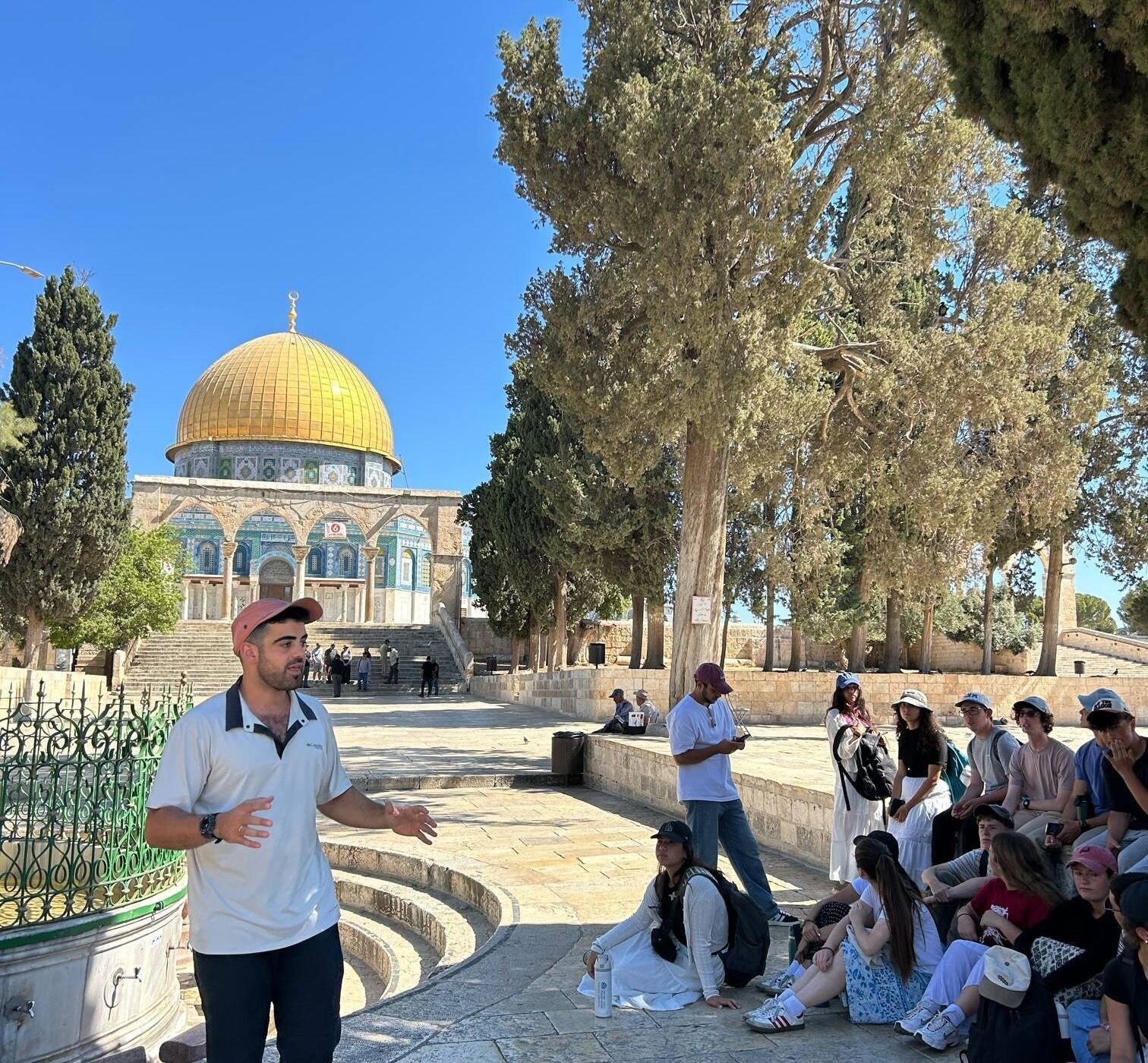
The Temple Mount is a raised platform of about 37 acres in Jerusalem’s Old City, known in Islam as the Haram al-Sharif. The Noble Sanctuary. It is the site of the First and Second Temples in Jewish tradition, the place where Jewish tradition locates the binding of Isaac, and in Islam the site of the Prophet Muhammad’s night journey and ascension. The Dome of the Rock, completed in 691 CE, stands at its center; al-Aqsa Mosque stands at its southern end.
It is the most contested religious site on earth, and visiting it involves rules that exist nowhere else. Non-Muslims may enter only through one gate, only during limited hours, and may not pray. Understanding why those rules exist is most of what makes a visit worth doing.
Who controls the Temple Mount?
Control is divided, which is the root of nearly everything else.
Israel has held sovereignty over the Old City since 1967. Administration of the site itself, however, remained with the Jordanian Waqf, the Islamic trust that has managed it for centuries. Israeli police control access and security at the gates. This arrangement — usually called the Status Quo — has governed the site since 1967 and is renegotiated in practice, not on paper.
The practical result: Israeli police decide who goes up and when; the Waqf governs what happens inside; and any change to either is treated by all parties as a serious matter.
Can visitors go up, and what are the rules?
Yes, non-Muslims can visit, within real constraints.
- One entrance only. Non-Muslims enter via the Mughrabi Bridge, the wooden ramp beside the Western Wall plaza. All other gates are for Muslim worshippers.
- Limited hours, typically two short windows on Sunday to Thursday mornings, subject to change without notice.
- Closed to non-Muslims on Fridays and Saturdays and throughout Ramadan.
- No non-Muslim prayer. This is enforced, and it is one of the most contested rules in the country.
- No religious articles — no bibles, prayer books or ritual items.
- Modest dress, strictly enforced. Shoulders and knees covered, for everyone.
- You may not enter the buildings. The Dome of the Rock and al-Aqsa are closed to non-Muslims.
Expect a queue and a security check. The window is short and the line forms early.
Why do many observant Jews not go up?
This surprises visitors who assume the site is the focus of Jewish worship.
Because the exact location of the Holy of Holies — the inner sanctum only the High Priest could enter, once a year — is not known with certainty, much rabbinic authority holds that Jews should not ascend at all, for fear of treading on it in a state of ritual impurity. The Chief Rabbinate posts signs to that effect at the entrance.
Other rabbinic authorities disagree and permit ascent along specified routes. The disagreement is live and, in recent decades, increasingly political. It is why the Western Wall below became the focus of Jewish prayer: it is as close as one can come to the site without going onto it.
What is the Dome of the Rock?
Completed in 691 CE under the Umayyad caliph Abd al-Malik, it is among the oldest surviving works of Islamic architecture anywhere and one of the earliest surviving domed buildings in the world.
It is a shrine, not a mosque, built to enclose the rock at its center. That rock is identified in Jewish tradition as the Foundation Stone, and in Islamic tradition as the point of the Prophet’s ascension. The gold covering the dome is modern; it was funded by King Hussein of Jordan in the 1990s, reportedly by selling a house in London.
How should you visit?
Go early, on a Sunday to Thursday, and treat the hours as the fixed point the rest of the day is planned around. Bring a passport. Leave religious articles at the hotel.
If the window closes or the site shuts at short notice — which happens — the alternatives are genuinely good: the Western Wall Tunnels run beneath the platform’s western retaining wall, and the Southern Wall excavations expose the steps pilgrims actually climbed to reach it.
Most visitors find the viewing more affecting than they expect, and the reason is scale. From the ground the platform reads as a plaza. Standing on it, you understand that the whole thing is artificial: an engineered surface Herod built to level a hilltop, and the reason the retaining walls below are as vast as they are.
Where it fits in a Jerusalem itinerary
The Temple Mount, the Western Wall and the Old City’s four quarters are one continuous morning. Because access here is the least predictable element in Jerusalem, it usually goes first and everything else flexes around it.
It pairs naturally with the Abrahamic Religions day, which treats the site as the meeting point of three traditions rather than the property of one, and with the City of David and Old City day, which arrives at the platform from below, the way pilgrims did.
Nearby
Dome of the Rock
The gold-domed shrine on Jerusalem’s Temple Mount, completed in 691. Whether non-Muslims can go in, when the platform…
Via Dolorosa
The Via Dolorosa runs 600 meters through the Old City, marking fourteen Stations of the Cross. A devotional…
Garden of Gethsemane
The Garden of Gethsemane sits at the foot of the Mount of Olives. Its olive trees date to…