

Mount of Olives
The best view of the Temple Mount, the oldest continuously used cemetery in the world, and a walk downhill through most of the Passion narrative.
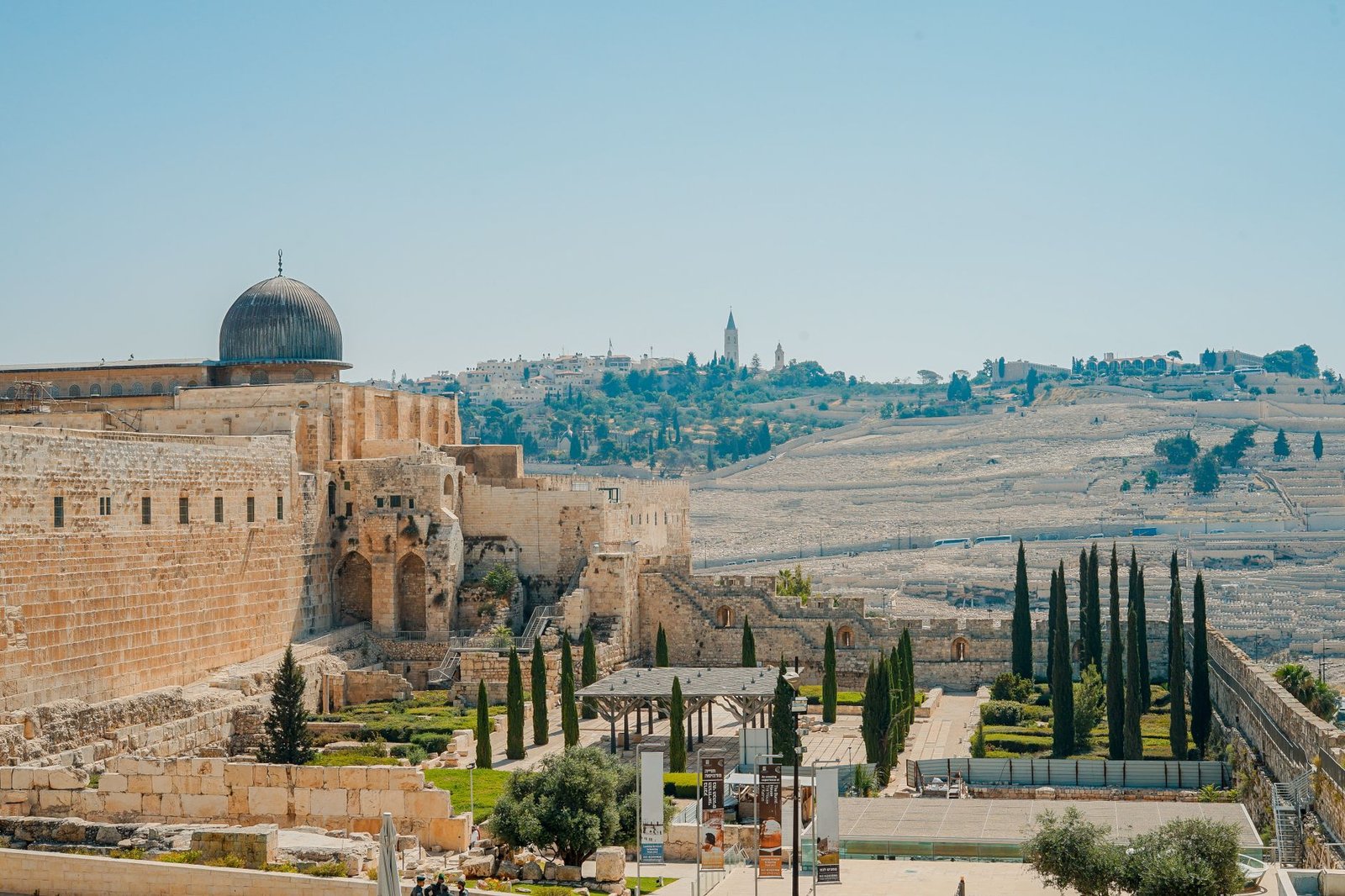
The Mount of Olives is the ridge running along the eastern side of Jerusalem, separated from the Old City by the Kidron Valley. It rises about 800 meters above sea level, roughly 80 meters above the Temple Mount opposite it, and that difference is the whole point: it is the one place you can stand and see the entire walled city laid out at eye level.
Why the view matters
Almost every photograph you have seen of Jerusalem — the golden Dome of the Rock, the gray domes of the Holy Sepulchre, the crenellated Ottoman wall — was taken from this ridge. It is not a coincidence of tourism. From up here the city’s geography finally makes sense: you can see that the Temple Mount is a raised artificial platform, that the Old City sits on two hills with a filled valley between them, and that the whole thing is far smaller than it feels when you are inside it.
Most itineraries begin the Jerusalem day here for exactly that reason. Everything you walk through afterwards is easier to hold in your head once you have seen it from above.
The cemetery
The western slope is covered in white stone graves: roughly 150,000 of them, in continuous use for around 3,000 years. It is the oldest Jewish cemetery still in use anywhere, and burial here has been sought for millennia because of the tradition that the resurrection of the dead will begin on this hillside.
The stones on the graves are not decoration. Leaving a stone rather than flowers is the Jewish practice of marking a visit: a mark that does not wilt.
Prominent figures buried here range from prophets traditionally associated with the site to modern Israeli political and rabbinic leaders. It is a working cemetery, not a monument, and it should be walked through quietly.
What is on the slope
The descent from the summit to the Kidron passes several distinct sites, and they can be linked into a single walk down.
The Chapel of the Ascension sits near the top: a small octagonal structure, originally Crusader, converted to a mosque, marking the traditional site of the Ascension. It is modest to the point of being easy to miss.
The Pater Noster Church, just below, is a Carmelite compound where the Lord’s Prayer is displayed on ceramic tiles in well over a hundred languages. Finding your own is genuinely one of the small pleasures of the day.
Dominus Flevit — “the Lord wept” — is a small church shaped like a teardrop, built in 1955 over Byzantine and Crusader remains. Its window frames the Old City behind the altar, which is the single best composed view on the mountain. The site is associated with the account of Jesus weeping over Jerusalem.
The Church of Mary Magdalene is the Russian Orthodox church with seven gold onion domes visible from across the valley. Built in 1888 by Tsar Alexander III in memory of his mother, it is the most photographed building on the slope and open only limited hours.
Gethsemane and the Church of All Nations sit at the bottom. The garden holds olive trees whose root systems have been dated to well over 900 years, making them among the oldest living olive trees known. The church beside it, completed in 1924 and funded by twelve countries, is deliberately kept dim, violet-tinted alabaster windows produce a permanent dusk, which is the intended effect for a place remembered for a night of anguish.
Adjacent is the Tomb of the Virgin Mary, reached down a broad Crusader stairway into a cool underground church, and the Grotto of Gethsemane.
Practical notes
Go down, not up. Start at the summit viewpoint and walk down toward the Kidron. The reverse is a steep, exposed climb on uneven paving, and there is no shade worth the name.
The path down is genuinely steep in sections and slippery when wet, with polished stone in places. Proper shoes matter here more than at most Jerusalem sites.
Modest dress is required at all the churches: shoulders and knees covered, for everyone.
Opening hours are irregular and vary by church, and most close for a long midday break. Mary Magdalene in particular opens only a few mornings a week. This is a place where arriving without checking wastes real time.
Early morning is best: the light falls on the Old City rather than into your camera, the temperature is manageable, and the coach groups have not yet arrived.
There is a camel at the main viewpoint and a persistent trade in photographs with it. That is entirely optional.
How much time it takes
The viewpoint alone takes fifteen minutes. Walking the full descent with stops at three or four of the churches is a comfortable half day, and it lands you at the Lions’ Gate, which is a natural entrance into the Old City for the afternoon.
It pairs most often with the Old City itself, the Via Dolorosa, and the City of David: all of which are visible from the top, which is the argument for starting here.
Nearby
Dome of the Rock
The gold-domed shrine on Jerusalem’s Temple Mount, completed in 691. Whether non-Muslims can go in, when the platform…
Via Dolorosa
The Via Dolorosa runs 600 meters through the Old City, marking fourteen Stations of the Cross. A devotional…
Garden of Gethsemane
The Garden of Gethsemane sits at the foot of the Mount of Olives. Its olive trees date to…