Private day tour
Old City Jerusalem Tour
All four quarters of Jerusalem's Old City in one day: the Western Wall, the Holy Sepulchre, the Via Dolorosa and the Temple Mount, with a licensed private guide.
A private Old City Jerusalem tour walks all four quarters — Jewish, Christian, Muslim and Armenian — in a single square kilometer that holds three thousand years of continuous history. A full day covers the Western Wall, the Church of the Holy Sepulchre, the Via Dolorosa and the Temple Mount viewing points, with the route built around what you actually came to see.
What is the Old City?
The Old City is the walled square kilometer at the heart of Jerusalem: 0.35 square miles, about nine hundred meters on its longest side, and small enough to cross on foot in twenty minutes if nothing stops you. Something always stops you.
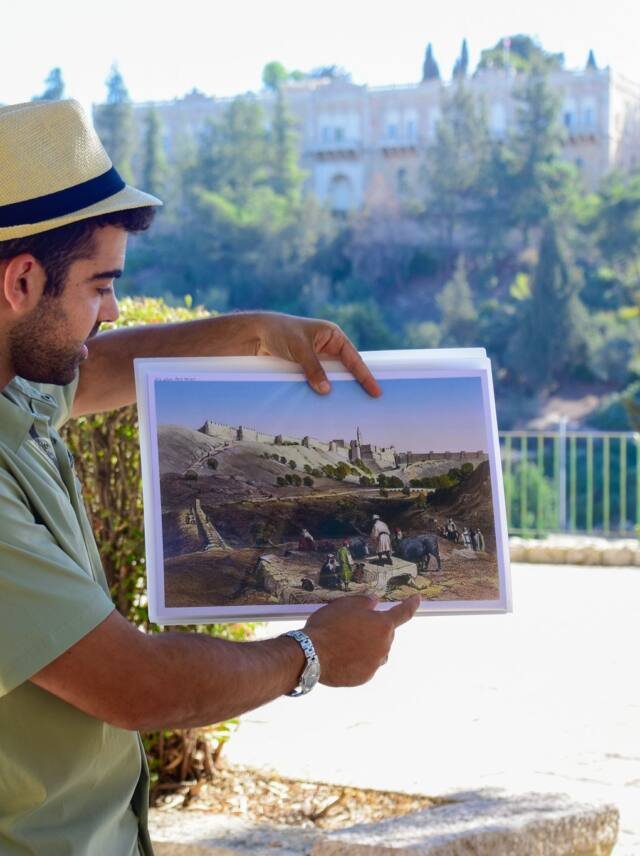
The walls you see are Ottoman, built by Suleiman the Magnificent between 1537 and 1541. What they enclose is far older: the Herodian retaining walls of the Temple Mount, a Roman street grid still legible under the modern paving, Crusader arches, Mamluk facades, and neighborhoods where families have lived for generations.
It is divided into four quarters, and those divisions are administrative conveniences from the nineteenth century rather than ancient boundaries. In practice the edges blur, which is itself one of the more interesting things to notice as you walk.
-
01
Jewish Quarter
Rebuilt after 1967, so it looks newer than the rest. Beneath it: the Cardo, the Roman main street, and the Broad Wall from Hezekiah’s expansion.
-
02
Christian Quarter
Built around the Church of the Holy Sepulchre. Dense with chapels belonging to denominations that have shared this ground, uneasily, for centuries.
-
03
Muslim Quarter
The largest and most populated. The Via Dolorosa runs straight through its market, which is why that walk is louder than most visitors expect.
-
04
Armenian Quarter
The smallest and quietest, and the one almost everyone skips. The community has been here since the fourth century.
What does the tour cover?
A full day covers the sites below. A half day covers roughly the first four. The order changes depending on the day of the week, because several of these control their own access.
- The Western Wall The exposed sixty meters of a retaining wall that runs nearly five hundred. Not a wall of the Temple — a wall of the platform it stood on, which is a distinction worth having before you arrive.
- The Western Wall Tunnels The rest of that wall, underground: the Western Stone at 250–300 tons, Wilson’s Arch, and a stretch of Herodian street. Timed entry, and it sells out. This is usually the fixed point the day is built around.
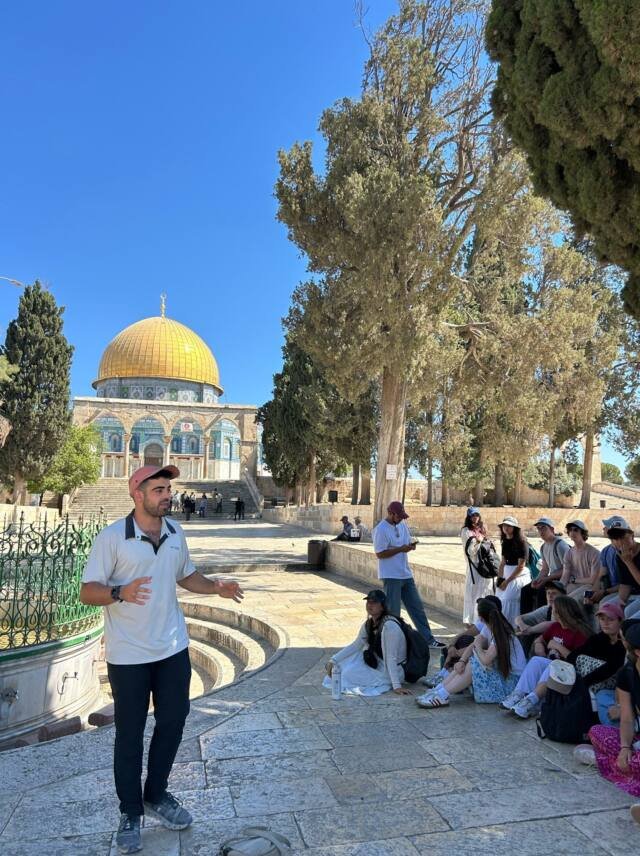
- The Temple Mount viewing points Access for non-Muslims runs in two short morning windows, Sunday to Thursday. When it is closed, the rooftop and southern-wall vantage points do the job.
- The Church of the Holy Sepulchre Six denominations, one building, and a ladder nobody has been able to move since the eighteenth century. The last five Stations of the Cross sit under this roof.
- The Via Dolorosa Six hundred meters, fourteen stations, straight through a working market. A devotional route rather than an archaeological one, and better for knowing the difference.
- The Jewish Quarter and the Cardo The Roman main street, excavated several meters below today’s level, plus the Hurva Synagogue and rooftop views across all four quarters at once.
How does a day in the Old City actually run?
It starts early. By ten in the morning in season the souk is shoulder to shoulder, and the sites that need queuing are already queuing.
The usual shape is to enter through one gate and leave through another rather than doubling back: Jaffa Gate down through the Christian Quarter, or the Lions’ Gate if the day is built around the Via Dolorosa. Entering from the Mount of Olives side and walking down is the version that makes the geography make sense, because you see the whole city before you are inside it.
Lunch is in the Old City. There is no reason to leave, and the food in the Muslim and Armenian Quarters is considerably better than the tourist frontage on the main routes suggests.
Two things reshape the schedule and neither is negotiable. Friday and Saturday close different sites — the Temple Mount is shut to non-Muslims both days, the Jewish Quarter shuts from Friday afternoon, and the Christian sites stay open throughout. And the Western Wall Tunnels run in timed groups that book out days ahead in high season. Those two decide which day of the week the tour runs.
Why take a guide rather than walk it alone?
The Old City is genuinely walkable alone, and plenty of people do it. The honest case for a guide is threefold.
Access. Knowing the hours, which entrance non-Muslims use for the Temple Mount, what needs booking and how far ahead, and what to do when a site closes at short notice, which happens.
Orientation. The Old City is a maze by design. Most first-time visitors spend a meaningful part of their day lost, and the parts they miss are usually the quiet ones worth seeing.
The layers. Without someone separating them, the Ottoman wall, the Crusader arch, the Herodian stone and the Roman street are all just old. Knowing which is which, and which claims are ancient and which are medieval devotional tradition, is the difference between seeing the Old City and understanding it.
Practical details
- Duration
- Full day, six to eight hours. A half day of four to five hours covers the Western Wall, the Holy Sepulchre and the Jewish Quarter.
- Best days
- Sunday to Thursday. Friday and Saturday close different sites and the souk is at its most crowded on Friday.
- Dress
- Shoulders and knees covered, for everyone. Enforced at the Western Wall, the Holy Sepulchre and strictly at the Temple Mount.
- Walking
- Uneven, polished stone with steps and real gradients. Proper shoes matter here more than almost anywhere else in the country.
- Advance booking
- The Western Wall Tunnels need booking days ahead in high season. We handle it.
- Bring
- Passport, water, hat, and a head covering for men at the Western Wall. One is provided if you do not have your own.
- Accessibility
- Parts of the route are difficult for limited mobility. Tell us in advance and the day is rebuilt rather than abandoned.
- Pricing
- Quoted per group, depending on numbers, season and length. Ask and we will come back with a figure.
Common questions
How long do you need in the Old City?
A full day does it properly. Half a day covers the headline sites and leaves you aware of what you skipped. Two days is not excessive if the history is why you came: most people who do one day say afterwards they would have taken two.
Can you visit the Temple Mount on this tour?
Sometimes. Non-Muslims may enter only via the Mughrabi Bridge, only during two short morning windows Sunday to Thursday, and not at all on Fridays, Saturdays or during Ramadan. Hours change without notice. We plan around it and use the viewing points when it is closed. Full detail on the Temple Mount page.
Is the Old City suitable for children?
Yes, and the tunnels are usually what they remember. The walking is real, so the day gets shorter and the stops get more physical — the Cardo, the ramparts, the tunnels — rather than more explanatory.
Is it safe to walk the Muslim Quarter?
It is a residential and commercial neighborhood that thousands of people walk daily. Conditions can change, and if a route is not sensible on your dates we will say so and rebuild the day. See our guide on safety for the sources to check yourself.
What is the difference between this and the City of David tour?
The City of David is outside the walls, below the Old City, and covers the older layer: the ridge Jerusalem actually began on and the tunnels running up from the spring. The two combine into one long day that runs bottom to top, which is how pilgrims arrived.
Three thousand years in one square kilometer.
Every empire that wanted this city took this hill. The walls are Ottoman, the streets Roman, the foundations older still — and people still live on top of all of it.