

Via Dolorosa
The Via Dolorosa runs 600 meters through the Old City, marking fourteen Stations of the Cross. A devotional route, not an archaeological one, and better for knowing the difference.
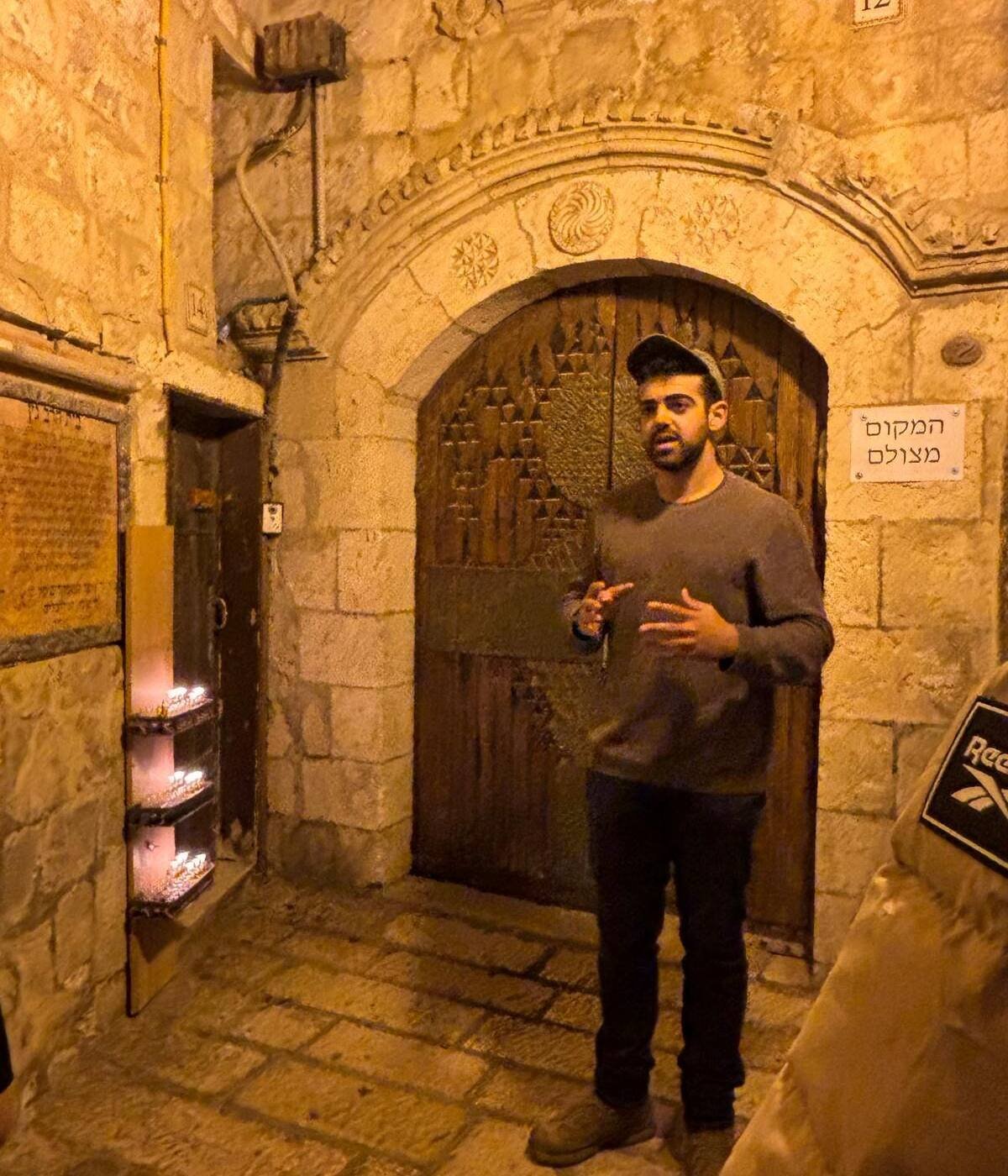
The Via Dolorosa — Latin for “the sorrowful way” — is a route of roughly 600 meters through Jerusalem’s Old City, marking fourteen Stations of the Cross along the traditional path from Jesus’s condemnation to his crucifixion and burial. It begins near the Lions’ Gate in the Muslim Quarter and ends inside the Church of the Holy Sepulchre, where the final five stations sit under one roof.
It is a devotional route rather than an archaeological one. The street level of the first century lies several meters below the paving you walk on, and the stations were fixed by tradition and pilgrimage practice over centuries, not by excavation. Knowing that does not diminish the walk. It changes what you are doing on it.
What are the fourteen stations?
| # | Station | Where |
|---|---|---|
| 1 | Jesus is condemned | Umariya School, near the Lions’ Gate |
| 2 | He receives the cross | Church of the Flagellation / Condemnation |
| 3 | He falls the first time | Polish Chapel, at the El-Wad junction |
| 4 | He meets his mother | Armenian Catholic Church |
| 5 | Simon of Cyrene takes the cross | Franciscan chapel, start of the climb |
| 6 | Veronica wipes his face | Greek Catholic chapel |
| 7 | He falls the second time | At the souk crossing |
| 8 | He speaks to the women of Jerusalem | Wall marker, Greek Orthodox monastery |
| 9 | He falls the third time | Coptic patriarchate, above the Sepulchre |
| 10–14 | Stripping, crucifixion, death, deposition, burial | All inside the Church of the Holy Sepulchre |
Is this the historical route?
Almost certainly not in detail, and the honest version is more interesting than the confident one.
The route depends on where Pilate judged Jesus. The traditional start assumes the Antonia Fortress, north of the Temple Mount. Most current scholarship favors Herod’s palace, near today’s Jaffa Gate on the western side, which would mean the historical walk ran in roughly the opposite direction.
The fourteen stations themselves were not fixed until the eighteenth century, and were shaped substantially by European pilgrims recreating the walk at home. Several — the three falls, Veronica’s veil — come from tradition rather than the Gospels. Station 8’s marker is a stone set into a wall you would walk past without noticing.
What is genuinely old is the practice. Pilgrims have walked a commemorative route through this city since at least the Byzantine period. The path has moved; the walking has not stopped.
What is it actually like to walk?
Not solemn, and visitors are often unprepared for that.
The Via Dolorosa runs straight through a working market. You pass butchers, spice stalls, sweet shops, delivery carts and schoolchildren. Traders will offer you a crown of thorns. The stations are small wall plaques and Roman numerals, easy to miss without someone pointing them out.
Some pilgrims find the ordinariness jarring. Others find it the point. The original was not a quiet route either. It was a busy city on the eve of a festival.
The Franciscan procession walks the route every Friday afternoon, open to anyone. That is the version with prayer and singing at each station, and it is the one most worth joining if your dates allow.
Practical notes
- Roughly 600 meters, but allow 90 minutes to two hours with stops. The Holy Sepulchre alone takes 45 minutes.
- Uneven, polished stone with steps and a real climb between stations 5 and 9. Poor footing when wet.
- Modest dress throughout, and required at the Sepulchre.
- Go early. By 10am in season the souk is shoulder to shoulder.
- Fridays are busiest. The Muslim Quarter is at its most crowded and the Franciscan procession runs in the afternoon.
- Most chapels along the route close for a long midday break.
Where it fits
The walk ends inside the Church of the Holy Sepulchre, so the two are one continuous visit and should always be planned together.
It sits in the middle of the Abrahamic Religions day, between the Temple Mount and the Christian Quarter. With a guide, the value is not the plaques. You could find those alone. It is knowing which claims are ancient, which are medieval, which are devotional, and why a route that probably ran the other way is still worth walking.
Nearby
Dome of the Rock
The gold-domed shrine on Jerusalem’s Temple Mount, completed in 691. Whether non-Muslims can go in, when the platform…
Garden of Gethsemane
The Garden of Gethsemane sits at the foot of the Mount of Olives. Its olive trees date to…
Temple Mount
The Temple Mount, or Haram al-Sharif, is a 37-acre platform in Jerusalem sacred to Judaism and Islam. Visiting…