

Western Wall Tunnels
The Western Wall most visitors see is about seventy meters long. The wall itself runs for four hundred and eighty-eight, and most of it is underground.
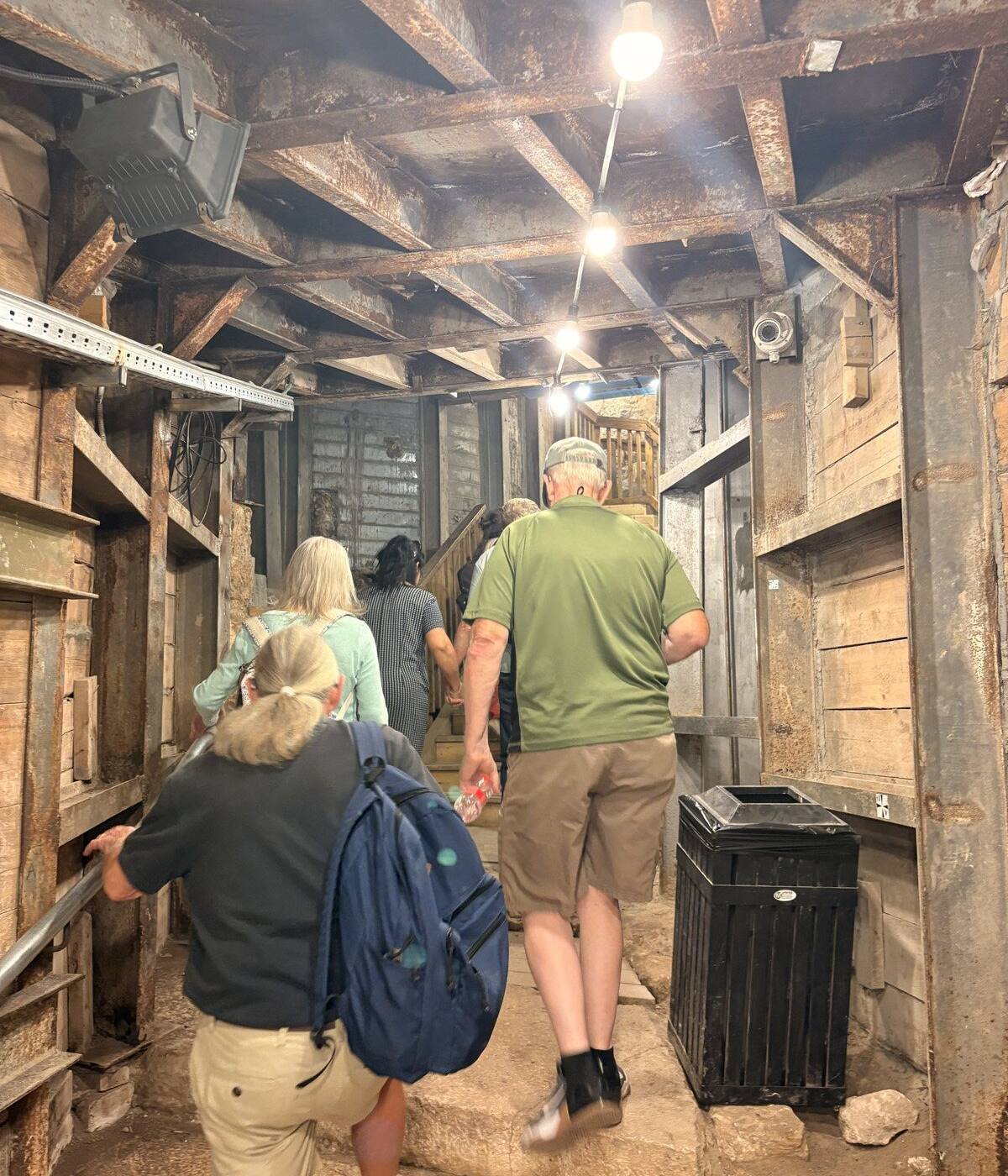
The Western Wall you see in photographs is about 60 meters of exposed stone. The wall itself runs for roughly 488 meters. Almost all of it is underground, and the tunnels are how you walk its length.
What you are actually walking along
This is not a wall of the Temple. It is a retaining wall of the platform the Temple stood on. When Herod the Great expanded the Temple Mount around 20 BCE, he needed to turn an uneven hilltop into a vast level esplanade. That meant building enormous supporting walls and filling behind them. The Western Wall is the western face of that engineering.
Understanding that changes what you are looking at. The stones are not sacred because they were part of a sanctuary. They are the closest accessible remnant of the structure that held the sanctuary up, and for most of the last two thousand years they were the nearest a Jew could get to the site itself.
The Western Stone
Partway along the tunnel you reach the largest stone in the wall, and one of the largest building stones anywhere in the ancient world. It is roughly 13.6 meters long, about 3 meters high, and estimated at somewhere between 250 and 300 tons.
There is no satisfying explanation for how it was moved. It was quarried nearby and manoeuvred into place without iron tools capable of the job, without wheels that could bear it, and without mortar. It sits in a course of similarly vast stones, cut so precisely that the joints are barely visible.
Herodian stonework is recognizable once you have seen it. Each block has a flat, slightly recessed border chiselled around a smooth raised center. The effect is that a wall of colossal weight reads as ordered rather than brutal.
The street, the arch and the aqueduct
The tunnel route passes several distinct periods stacked on one another.
There is a section of Herodian street — the actual paving that ran along the base of the wall in the first century, where pilgrims and traders moved past shops cut into the wall’s lower courses. Standing on it puts you at the ground level of the period rather than the modern one, which is several meters higher.
Wilson’s Arch is the surviving span of a bridge that carried a road and an aqueduct from the Upper City across the valley to the Temple Mount. It is one of very few Second Temple structures still standing to full height, and the space beneath it is now used as a prayer hall.
Further along, the route passes a Hasmonean aqueduct channel, cut to bring water into the city, and a large Struthion Pool — a Hasmonean-era reservoir later vaulted over by Hadrian.
The closest point
At one point the tunnel reaches the spot on the wall geographically nearest to where the Holy of Holies is believed to have stood. There is a small prayer area there, and it is often the busiest and quietest part of the route at the same time, busy with people, quiet in atmosphere.
Whatever you believe, it is worth pausing to register what you are standing in: a corridor cut through two millennia of accumulated city, ending at a wall that people have oriented their prayers toward from every continent.
Practical notes
You must book in advance. This is the single most important thing to know. The tunnels are entered in timed, guided groups only: you cannot turn up and walk in. Slots sell out days ahead in high season and around festivals.
The route is roughly 45 to 75 minutes depending on the group and the guide. It is largely one-way, narrow in places, with steps and uneven ancient paving. It is not a good fit for anyone with significant mobility limitations, and it is genuinely tight if you are uneasy in confined spaces.
Modest dress is expected. This is an active religious site. Head covering is provided for men at the prayer areas.
The temperature underground is steady and cool, which is a relief in August and worth a layer in January.
Photography is allowed along most of the route but not in the prayer sections.
Where it fits in a day
The entrance is at the northern end of the Western Wall plaza, in the Jewish Quarter. Because entry is by timed slot, it tends to become the fixed point that the rest of a Jerusalem day is built around.
It pairs naturally with the plaza itself, the Jewish Quarter, and the Cardo. Combined with the City of David and the Pilgrimage Road, you get the full vertical story: the spring the city started at, the street pilgrims climbed, and the wall they arrived at.
Most people find the tunnels the moment Jerusalem stops being a series of sites and becomes a single continuous place.
Nearby
Dome of the Rock
The gold-domed shrine on Jerusalem’s Temple Mount, completed in 691. Whether non-Muslims can go in, when the platform…
Via Dolorosa
The Via Dolorosa runs 600 meters through the Old City, marking fourteen Stations of the Cross. A devotional…
Garden of Gethsemane
The Garden of Gethsemane sits at the foot of the Mount of Olives. Its olive trees date to…