

Capernaum
A fishing village of maybe 1,500 people that the Gospels call “his own city”, and where you can stand in a first-century house and a fourth-century synagogue in the same visit.
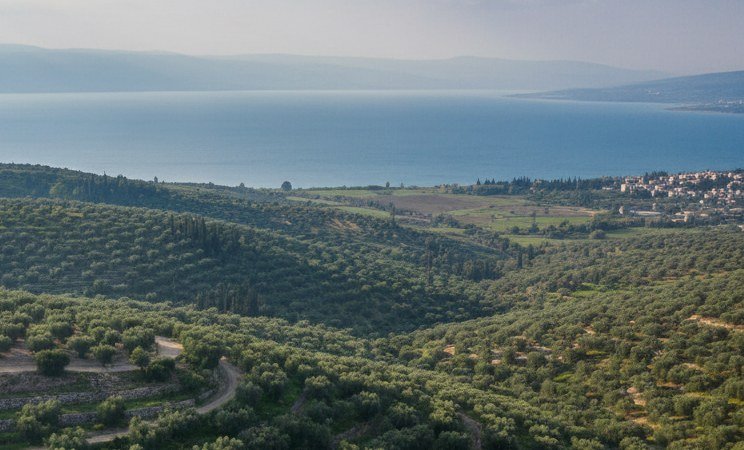
Capernaum sits on the north-west shore of the Sea of Galilee, a small excavated village of black basalt about 200 meters deep and a few hundred wide. It was a fishing settlement of perhaps a thousand people in the first century. It is described in the Gospels as the base Jesus worked from — Matthew calls it “his own town” — and more of the recorded events happen here than anywhere except Jerusalem.
What makes it worth the stop is not size. It is that the village was abandoned, never built over, and excavated carefully. You are walking a first-century street plan, not a reconstruction of one.
The two synagogues
The most striking building on the site is the white limestone synagogue, with carved columns, benches along the walls and a decorated frieze. It is usually dated to the fourth or fifth century, which is several hundred years after the Gospel period, and visitors are sometimes disappointed to learn that.
The important detail is underneath it. The white building sits directly on a foundation of black basalt walls belonging to an earlier synagogue. The first-century one. You can see the join clearly: dark stone below, pale stone above. Later builders did not choose that spot at random. They rebuilt on the older sanctuary because it was the older sanctuary.
So the structure you photograph is late Roman. The footprint it stands on is the building the accounts describe.
Peter’s house
A short walk from the synagogue, a modern church stands on stilts over an excavation, with a glass floor so you can look down into it. The building below is an ordinary first-century basalt house of the local type: small rooms around a courtyard, shared walls with neighbours.
Three things set it apart from the houses around it. Its main room was plastered, which domestic rooms in this village were not. The pottery found in it shifts from household ware to lamps and storage jars, suggesting the room stopped being lived in and started being gathered in. And the plaster carries graffiti scratched by visitors in Greek, Aramaic and Syriac, some of it invoking Peter by name.
By the fifth century an octagonal church had been built directly over the room. Octagons were reserved for sites of particular significance. The archaeological case that early Christians venerated this specific house as Peter’s is unusually strong, whatever conclusion you draw from that.
The rest of the village
Between the two focal points, the excavated housing blocks are worth slowing down for. The walls are low now, but the plan is legible: dense, small, doorways opening onto shared courtyards where cooking and work happened outdoors. There was no privacy in a village like this, and the domestic geography of the Gospel accounts — crowds at the door, a roof opened up to lower someone through — reads very differently once you have seen how these houses were actually built.
There is also a first-century olive press, milling stones, and a stretch of the paved street running toward the shore. The lake is a two-minute walk away, which is the other thing the site makes obvious: the synagogue, the houses and the water are all within a few hundred meters of one another.
A Greek Orthodox church with red domes stands just to the east, on the adjacent property. It is a separate site with separate hours.
Practical notes
Capernaum is a Franciscan-administered site and charges a modest admission.
The dress code is enforced, and enforced strictly. Shoulders and knees covered, for men and women both. People are turned away at the gate here more than at most sites in the country. Shorts will be a problem.
The site closes in the mid-afternoon — earlier than most visitors expect — and does not reopen. Check the day’s hours before building an itinerary around it.
There is very little shade among the ruins, and black basalt holds heat. In summer, come in the morning.
The ground is uneven ancient paving with low walls and steps, though the main paths are largely flat and the site is small, which makes it more manageable than most excavations for anyone moving slowly.
Where it fits in a day
Capernaum, Tabgha and the Mount of Beatitudes sit within a couple of kilometers of one another on the northern shore and are almost always visited together. That cluster is a comfortable half day.
Add Magdala, a boat crossing, or the first-century boat at Ginosar and it becomes a full one. Capernaum is usually placed first, because the village gives you the scale of the world the other sites belong to before you see the churches built to commemorate it.